
The Supreme Court said on Thursday it will examine the larger constitutional issue of challenge to the validity of extrajudicial divorce like 'talaq-e-hasan' among Muslims.

The Supreme Court of India has reprimanded a Karnataka High Court judge for passing an inconsistent verdict, highlighting the crucial importance of consistent judicial outcomes for maintaining public trust. The court emphasized that inconsistent decisions from different benches undermine faith in the judiciary and can lead to "forum shopping" and other unethical practices.

A Gujarat-based couple's 23-year marriage ended in divorce due to a long-standing dispute over the wife's dietary choice of not consuming onion and garlic. The Gujarat High Court upheld the divorce verdict.

The high court said it is essential to ensure the perpetrators of such crimes are held accountable through appropriate legal proceedings.

Independent directors of Raymond Ltd on Friday said they are monitoring the situation arising out of the matrimonial dispute of company's Chairman and Managing Director Gautam Singhania to ensure it does not affect his capacity to manage the affairs and business of the firm. In a joint communication shared on BSE by the company, the independent directors also said they have decided to retain Berjis Desai, a senior independent legal counsel, who has no links with promoters or the company, for advising them.

The Supreme Court of India has ruled that a daughter has an indefeasible right to secure educational expenses from her parents, who can be compelled to provide necessary funds within their means. This ruling came in a matrimonial dispute where a daughter studying in Ireland refused to accept Rs 43 lakh given by her father towards her studies, which was part of the total alimony being paid to her mother. The court stated that the daughter has a fundamental right to pursue her education and that the parents can be compelled to provide necessary funds within their financial resources. The court also granted a decree of divorce by mutual consent to the estranged couple, directing them to abide by the terms of a settlement agreement they had reached.

A 71-year-old US citizen of Indian origin was murdered in Ludhiana, India, allegedly at the behest of a UK-based NRI man she was to marry. The victim was bludgeoned to death, her body burnt, and dumped in a drain.
The Supreme Court of India has ruled that family members of an accused in domestic violence cases cannot be implicated without specific charges. The court emphasized the need for sensitivity in handling such cases, noting that emotions run high in matrimonial disputes and there may be a tendency to indiscriminately implicate family members. The court stressed that criminalizing domestic disputes without specific allegations and credible evidence could have disastrous consequences for the institution of family.
The Supreme Court of India has dismissed a public interest litigation (PIL) seeking to make dowry harassment and maintenance provisions "gender neutral." The court stated that it cannot legislate law and it is the responsibility of Parliament to look into such matters. The PIL, filed by an NGO, argued that these provisions are often misused to harass husbands and their families. The court, however, emphasized that every case must be judged on its own merits, and that the provisions are intended to protect women and children. The court also noted that the allegation of misuse was vague and that such claims should be examined on a case-by-case basis.

The court ruled that the provision of interim maintenance during proceedings of the matrimonial disputes was applicable to both the spouses.

The Supreme Court stated that in a continuing marriage, neither husband nor wife can claim independence from their partner, emphasizing that marriage signifies the union of two souls.

Within a span of little over a month since Chief Justice D Y Chandrachud assumed office, the Supreme Court has disposed of 6,844 cases, including 2,511 bail and transfer petitions, sources said.
Chief Justice D Y Chandrachud on Friday said the Supreme Court, in its full court meeting, has decided that all the 13 benches will hear 10 transfer petitions pertaining to matrimonial disputes and equal number of bail petitions daily in a bid to lessen the pendency of cases.

An Islamic qazi cannot adjudicate a dispute and pass orders like a court, the Madhya Pradesh high court has said.
The Supreme Court of India has ruled that a wife is entitled to maintenance from her husband even if she refuses to cohabit with him after a decree for restitution of conjugal rights, provided she has valid and sufficient reasons for refusing to live with him. The court stated that the circumstances of each case must be considered individually and a decree for restitution of conjugal rights does not automatically disqualify a wife from receiving maintenance. This landmark ruling clarifies the legal interpretation of Section 125(4) of the Criminal Procedure Code (CrPC) regarding maintenance and emphasizes the importance of considering individual circumstances when determining a wife's right to maintenance.

A sessions court in Mumbai on Thursday convicted artist Chintan Upadhyay for abetting and conspiring to kill his wife wife Hema Upadhyay and her lawyer Haresh Bhambhani.

The Madhya Pradesh High Court will decide whether Jain individuals can seek relief under the Hindu Marriage Act, including divorce by mutual consent. This decision stems from a family court's refusal to accept a divorce petition from a Jain software engineer, citing the community's minority status. The high court appointed an amicus curiae to assist in the case, and the next hearing is scheduled for March 18.

Section 498-A of the IPC deals with the offence of subjecting a woman to cruelty by the husband or his relatives.
Bollywood singer Adnan Sami, who has been facing trial in a matrimonial dispute, has been asked by the Enforcement Directorate (ED) to furnish documents regarding eight luxurious flats owned by him in suburban Andheri.

The high court of Karnataka has disallowed a family court's order to a mobile service provider to submit the call details and mobile tower details of a third party in a matrimonial case between a couple.
Rejecting the husband's claim that the sole intention of his wife was to somehow get him arrested, the Supreme Court has dismissed the plea of an non resident Indian for cancellation of a NBW issued against him in a matrimonial dispute.

The amicable settlement of the matrimonial dispute between Bollywood actor Karisma Kapoor and her estranged businessman husband Sunjay Kapur with mutual consent, on Friday got a seal of approval from the Supreme Court.
The Lucknow bench of the court ruled that the provision of interim maintenance during proceedings of the matrimonial disputes was applicable to both the spouses.

Taking a strong view of Google pulling out some apps from its Play Store, the government on Saturday said delisting of Indian apps cannot be permitted and that the tech company and the startups concerned have been called for a meeting next week. In an interview to PTI, IT and Telecom Minister Ashwini Vaishnaw said the startup ecosystem is key to the Indian economy and their fate cannot be left to any big tech to decide. The minister's comments assume significance as Google on Friday began removing some apps, including popular matrimony apps, from its Play Store in India over a dispute on service fee payments, even as apps and well-known startup founders cried foul.

In the high courts, only 13.2 per cent women occupied the position of judge.
The apex court had in January held the man guilty of contempt for his failure to bring back his son to India in terms of a court order.

Google on Tuesday began reinstating about 250 Indian apps it had delisted from its Play Store over a billing dispute as it caved in to government criticism, but the squabble may not yet be over.
The top court said the direction to create family welfare committees in every district and the power conferred in them was 'not in accord with the statutory framework'.

A husband has no control over his wife's 'stridhan' (woman's property) and while he may use it during the time of his distress, he has a moral obligation to return it to his wife, the Supreme Court has reiterated while directing a man to pay Rs 25 lakh to a woman in return for her lost gold.

'Being financially independent is crucial.' 'This spares women a lot of grief if the marriage, especially in large business families, breaks down.'

Along with the triple talaq matter, the Supreme Court will also hear cases related to Aadhaar and WhatsApp during the nearly 50-day summer vacation.

'How can he (man) be so unreasonable? He is treating her as a chattel. She is not an object'
A bench headed by Justice Suresh Kumar Kait, while dealing with an appeal of the wife who withdrew her consent for mutual divorce after a settlement, observed that the idea of a no-fault-divorce is to make the parties realise that there was a sensible way of parting on the agreed terms.

A unanimous decision was taken by the 30 judges of the apex court in the full court meeting headed by Chief Justice of India U U Lalit held on Tuesday evening to implement an apex court verdict of 2018 in the Swapnil Tripathi case.

The court also said that the "frivolous contentions" by the petitioner objecting to the PM's photo and his "morale boosting message" on the vaccination certificate, was "not expected from a citizen of the country".

The Supreme Court in its official communication called it "Truly, a historic day".

The Madras High Court on Tuesday came down heavily on lawyers donning the role of priests for effecting registration of marriages, saying such acts "performed in secrecy" in their offices and Bar Association rooms cannot amount to solemnisation.

The PM lauded the steps being taken by the CJI to make use of technology in simplifying the working in the courts and bring about qualitative change.

The Centre on Wednesday urged the Supreme Court that its 2018 verdict decriminalising colonial era offence of adultery under the Indian Penal Code be not made applicable to armed forces.
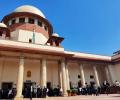
A bench of Justices Sanjiv Khanna and MM Sundresh said the word 'cruelty' under Section 13(1)(ia) of the Hindu Marriage Act of 1955 has no fixed meaning, and therefore, gives a very wide discretion to the Court to apply it "liberally and contextually".
